
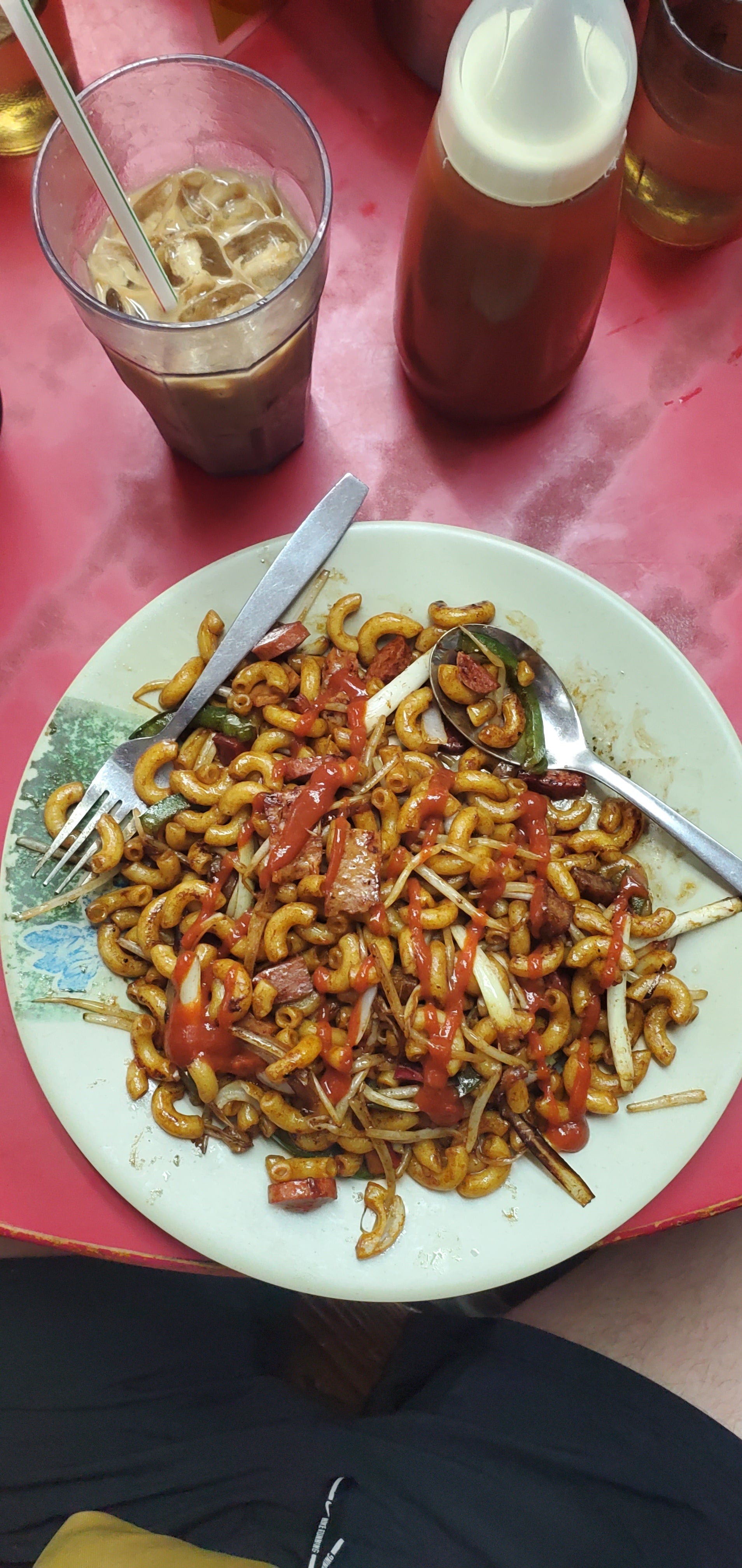
 This dish is inspired by my favourite cha chaan teng (Western-style cafe) in Hong Kong. The cafe is a classic of its genre: a small, independent diner in a working class neighbourhood of Kowloon, specialising in Western-influenced Chinese dishes such as french toast and baked pork chop rice. Its name translates to Fat Boy Ming’s Cafe (肥仔銘茶餐廳). Fat Boy’s character is truly on show in his restaurant: there’s a cartoon depiction of him on the menus and shopfront, and his collection of hundreds of Dragonball Z figurines adorn the walls. The food is excellent and affordable, Ming taking care to do the classics well without any corner-cutting with a joviality rarely seen in the heat of the lunch rush.
Ming’s best dish is his stir-fried macaroni. It’s not the most celebrated Hong Kong dish, but is emblematic of Hong Kong culinary pragmatism. Macaroni is always on hand, as almost every CCT in Hong Kong features macaroni chicken soup in their breakfast set. The macaroni is always boiled in advance, as the ever-rushing Hong Kongers expect their breakfast in a minute or less. After breakfast hours, what to do with the left-over macaroni? Stir-fry it, of course. Ming stir-fries the pasta like he would chow fun, using a sauce that complements the almost-smoky caramelisation you get from high-temperature wok cooking.
Obviously, macaroni is not a traditional ingredient in Cantonese cuisine, but in many ways it makes good sense to classic Chinese culinary principles: ingredients in stir fries should be by and large uniform in size and shape. There’s something incredibly satisfying about how the macaroni behaves in the pan, and the uniformity of the pasta with the cubed sausage and ham. As a carbohydrate, it's far easier to learn how to stir-fry than rice or noodles in my opinion.
My take is an adaptation of Fat Boy Ming’s dish, replacing the BBQ pork and sausage for a sweet lean Spanish chorizo that pairs well with the green peppers and spring onion. You could use whatever pork product you have on hand, or indeed, omit meat entirely. This dish is about precise cutting and stir-fry technique.
Unlike many Cantonese dishes, this dish is not designed to be shared, CCTs being spaces for the solo diner. If you are cooking for two, I would suggest scaling up by 70-80%, and doing a quick vegetable stir fry as an accompaniment. Scaling up by much more than 100% will crowd the pan, unless you have a very large wok set-up.

Happy cooking, and let us know how you get on with this recipe.
Love,
Sean
Share:
Celebrating Chinese home cooking at our first knife skills workshop!
Why Do Chinese Chefs Use Cleavers? The History Behind China's Most Misunderstood Knife (with a recipe for stir-fried potatoes)